
WW2 shoulder titles and formation signs: how to read his sleeve
Three or four bits of cloth on the top of his sleeve. Read them in order and they narrow down where he served.
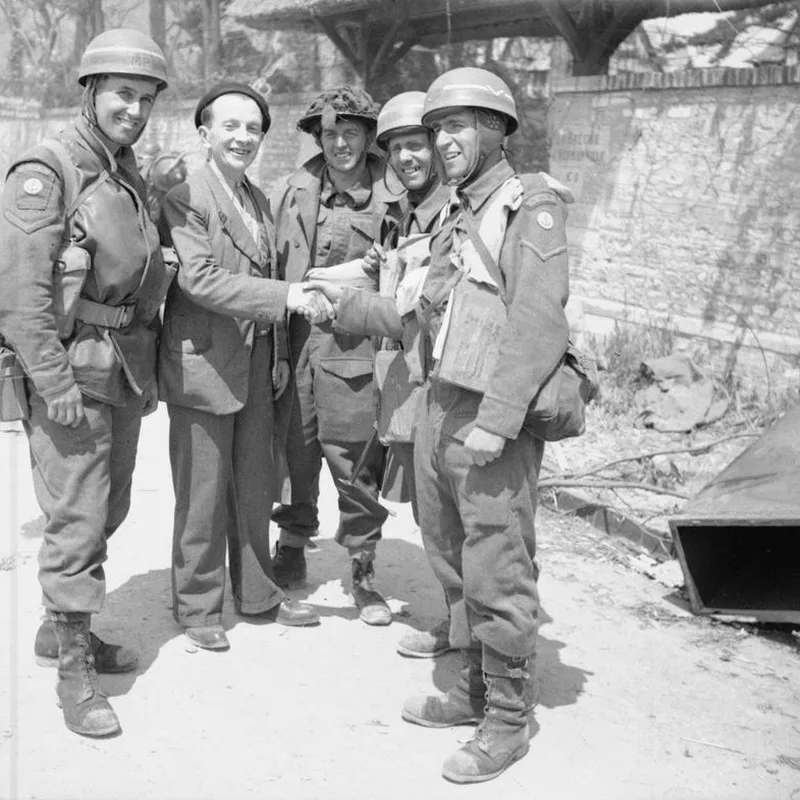

WW2 shoulder titles and formation signs are the cloth badges at the top of a British soldier’s battledress sleeve. The shoulder title names his regiment or corps. Below it, the formation sign shows the division, brigade or command he belonged to. Below that, one or more coloured strips show his arm of service. Read them top to bottom and you can narrow down where he served.
Key facts
- Shoulder title
- Names his regiment or corps. Worn at the top of the sleeve
- Formation sign
- Identifies his division, brigade, corps or command
- Arm of service strip
- A coloured strip below the sign showing his branch of the Army
- Authorised
- Formation signs on battledress from September 1940 (ACI 1118)
- Printed titles
- Collectors date official printed cloth titles to 1943
- Best use today
- Narrowing down his division and unit, then the war diaries
Based on the National Army Museum, Imperial War Museums, regimental and collector research, checked 3 November 2026.
A cap badge tells you his regiment. His sleeve can tell you his division.
Reading a sleeve, top to bottom
On battledress the order was fixed. The Lightbobs regimental research site, quoting Howard Cole’s Formation Badges of World War Two, says signs were worn “one inch below the regimental or corps shoulder title on battledress, and immediately above the arm of service strip”. Not on greatcoats.
So, from the shoulder seam down:
- Shoulder title. His regiment or corps.
- Formation sign. His division, brigade, corps or command.
- Arm of service strip. His branch of the Army.
- Anything else. Some battalions added their own regimental patch below the strips.
Shoulder titles: his regiment or corps
The shoulder title is the easy one. It usually spells out the regiment or corps, often abbreviated: a Durham Light Infantry title reads “DURHAM L.I.”.
Titles came in several forms:
- Metal titles. At the Lightbobs site, the Buckinghamshire Battalion’s blackened brass titles read “T” over “BUCKS”. Its war diary for 1 February 1940 records all shoulder titles being removed from battledress.
- Slip-on titles. Cloth loops that slid over the shoulder strap. The National Army Museum holds a slip-on title of the Queen’s Westminster Rifles, c.1940, with black embroidered lettering on dark khaki.
- Curved cloth titles. Sewn to the top of the sleeve. The same museum holds a Queen’s Westminsters title in black embroidered lettering on red felt, dated 1938 to 1950.
- Printed titles. Collectors on the British & Commonwealth Military Badge Forum say official printed titles were introduced in 1943, and unofficial embroidered ones were banned. Many regiments still bought embroidered versions.
Treat dates as rough. A title alone rarely proves exactly when it was worn.
Formation signs: his division or command
Where they came from
According to Wikipedia’s history of British divisional insignia, formation signs began in the First World War as a security measure, so units did not display their name in the open. In the Second World War the Army at first banned them on uniform. Army Council Instruction 419, issued in May 1940, banned division signs on uniforms.
That changed fast. In September 1940 ACI 1118 replaced it, and signs were allowed on uniform below the shoulder title. According to Cole, as quoted by Lightbobs, they were worn by all ranks of command headquarters, corps, divisions, independent brigade groups and independent infantry brigades. Each design was chosen by the commander and the War Office notified.
What the designs mean
Designs drew on almost anything: heraldry, local pride, a pun, or the formation’s role. Two examples with museum descriptions:
- 2nd Infantry Division: two white crossed keys on black. The National Army Museum says the keys came from the arms of the Archbishop of York and were adopted in 1940, chosen by the division’s commander.
- 59th (Staffordshire) Division: a black triangle on blue with a red pit winding tower. The Imperial War Museums’ description says the triangle is a slag heap, fitting for a division raised in the mining area of Staffordshire.
To identify an unknown sign, compare it with a chart. The National Army Museum holds one: a colour lithograph titled “Formation Signs 8 May 1945”, covering formations from 21st Army Group to Canadian, Polish, Czechoslovak and Dutch units.
Signs changed with the man
A soldier could wear several signs during the war, one for each formation he joined. The Lightbobs site shows this for the 1st Buckinghamshire Battalion. It wore the 48th Division sign from 1940 to December 1942, the 54th (East Anglian) Division sign from December 1942 to April 1943, and then the 3rd Division’s sign from November 1943 until shortly before D-Day, when a beach group sign replaced it. A beach group sign is what you can see on the sleeves in the photo at the top. The Imperial War Museums describe it as a red anchor on a pale blue background, worn by No. 5 or 6 Beach Group on D-Day.
So if you find two different signs in his tin, both may be right.
Arm of service strips: his branch
These narrow strips were introduced in autumn 1940. Cole, as quoted by Lightbobs, gives the colours as:
| Strip | Arm of service |
|---|---|
| Red | Infantry |
| Blue and red | Royal Artillery and Royal Engineers |
| Yellow and red | Royal Armoured Corps |
| Blue and yellow | Royal Army Service Corps |
Rifle regiments wore green. The Buckinghamshire Battalion had to write to the War Office to get its green strips in 1941.
Now the useful bit. Infantry battalions wore one, two or three strips, one below the other, to show which brigade of the division they belonged to. A photo on the Lightbobs site shows a 1st Bucks lance corporal with three green strips below the 48th Division sign, marking the division’s junior brigade.
Count the strips. It can take you from a division of thousands to a brigade of three battalions.
Using the sleeve to find his unit
- Read the shoulder title. That is his regiment or corps. Check it against any cap badge you have.
- Identify the formation sign. Match it against a chart. Note the division.
- Count the strips. For infantry, this may point to the brigade.
- Cross-check the dates. Signs changed when units moved, so match the sign to a period.
- Confirm with records. Our guide to finding which battalion grandad served in explains how. Then read the war diaries for that unit.
Only his service record proves where he served. The sleeve is a strong clue, not proof.
Loose badges in a tin
Badges often turn up off the uniform, with no context. Keep them together, and note which items came from the same tin. A sign found alongside his pay book or identity discs is far more useful than one on its own.
We can’t authenticate cloth badges, so treat any badge you did not inherit with caution.
Photograph each badge front and back before you do anything else. For storing fragile wartime items, our heirloom care guide covers the basics.
FAQ: WW2 shoulder titles and formation signs
What is the difference between a shoulder title and a formation sign?
The shoulder title names the regiment or corps, for example DURHAM L.I. The formation sign is a badge for the larger formation he belonged to, such as a division. On battledress the formation sign sat below the shoulder title, with a coloured arm of service strip below that.
When did British soldiers start wearing formation signs in WW2?
Army Council Instruction 1118 of September 1940 allowed formation signs to be worn on uniform below the shoulder title. It replaced ACI 419, issued in May 1940, which had banned division signs on uniforms.
What do the coloured strips under a formation sign mean?
They are arm of service strips. The Lightbobs regimental site quotes Howard Cole's book on formation badges: red for infantry, blue and red for Gunners and Sappers, yellow and red for the Royal Armoured Corps, blue and yellow for the RASC. Infantry battalions wore one, two or three strips to show which brigade of the division they belonged to.
Can a formation sign tell me his battalion?
Not on its own. It narrows him to a formation. Combined with his shoulder title and the number of strips, it can point to a brigade, and the war diaries can take you from there. His service record is the only sure answer.
Is a printed shoulder title wartime?
Possibly. Collectors on the British & Commonwealth Military Badge Forum say official printed titles were introduced in 1943 and later replaced by embroidered patterns. We cannot authenticate individual items, so treat any title as a clue rather than proof.
Where can I see a chart of WW2 formation signs?
The National Army Museum holds a 1945 colour lithograph, 'Formation Signs 8 May 1945', charting divisional and other signs, from 21st Army Group to Canadian, Polish and Czechoslovak formations.
Sources
Checked 3 November 2026.
- National Army Museum: 'Formation Signs 8 May 1945' (NAM.1961-11-197-1)
- National Army Museum: Formation badge, 2nd Infantry Division, 1953 (c)
- National Army Museum: Shoulder title, slip on, embroidered, Queen's Westminster Rifles, 1940 (c)
- National Army Museum: Shoulder title, Queen's Westminster Rifles, 1938-1950
- Imperial War Museums description of 59th (Staffordshire) Division badge INS 5394, via Wikimedia Commons
- Lightbobs (Oxfordshire and Buckinghamshire Light Infantry): Insignia and dress distinctions
- Wikipedia: Divisional insignia of the British Army
- Wikipedia: Higher formation insignia of the British Army
- British & Commonwealth Military Badge Forum: cloth shoulder titles WWII or post-WWII
