
- Home
- Letters & Documents
- The WW2 soldier's pay book (AB64)
The WW2 soldier's pay book (AB64): what it tells you
A small brown book he carried everywhere. It holds his number, his dates and sometimes his will.
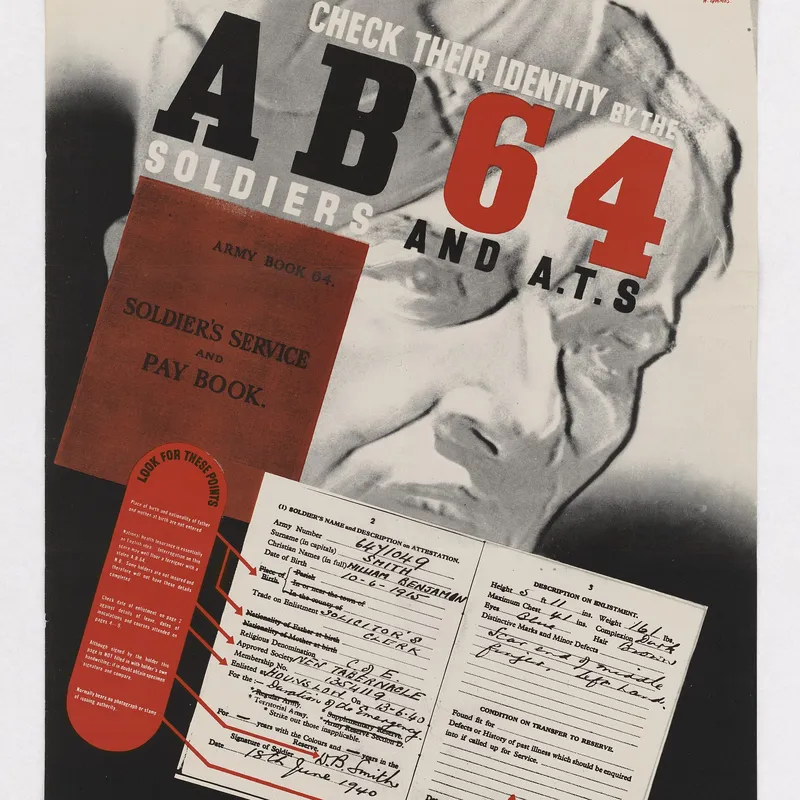

A WW2 soldier’s pay book, the AB64, is the Soldier’s Service and Pay Book (Army Book 64). It came in two parts. Part I travelled with him everywhere and recorded his regimental number, enlistment dates, rank, training and next of kin. Part II was issued only on active service and recorded his pay. If you have one, you probably have his service number. That is the key to his service record.
Key facts
- Full name
- Soldier's Service and Pay Book, Army Book 64 (AB64)
- Part I
- Carried at all times: number, enlistment dates, rank, training, next of kin
- Part II
- Issued only on active service; a record of pay
- Who had one
- Soldiers and ATS. RAF and WAAF carried blue identity cards instead
- Photograph?
- Normally none, except after leave to Eire or Northern Ireland
- Best use today
- His service number, to order his service record
Based on the National Army Museum, Imperial War Museums and GOV.UK, checked 2 November 2026.
Small book. Big clues.
What is an AB64?
The National Army Museum describes Army Book 64 Part I as a book “carried by a soldier at all times”. It held:
- regimental number
- dates of enlistment
- rank
- training
- next of kin
Part II was different. The museum says it was issued only on active service and was a record of pay.
The format was not new in 1939. The museum’s own example of Part I belonged to Georgina Baxter of the Women’s Army Auxiliary Corps, in papers dated 1917 to 1920. So the AB64 was already in use in the First World War.
Who carried one?
Soldiers, and women of the Auxiliary Territorial Service (ATS). A wartime Imperial War Museums poster by Abram Games, “Check Their Identity by the AB 64”, is addressed to “Soldiers and A.T.S.”
The same poster sets out who did not carry one:
- RAF and WAAF: blue identity cards with photographs.
- Sailors and Royal Marines: books similar to the AB64, issued in various colours, with photographs attached.
- Allied forces: the usual AB64, endorsed with nationality, plus a photograph.
So if your grandfather was in the RAF or the Navy, the document you are holding is probably something else. Our RAF WW2 service records and Royal Navy WW2 service records guides cover those services.
The National Army Museum holds real examples. One belonged to P/Lance Sgt Joe Ashley, Royal Armoured Corps, covering 1941 to 1946. Another was used by Muriel Penson, who enlisted in the ATS in London on 12 December 1938 and served throughout the war.
Why there was usually no photograph
It seems odd now. An identity document with no picture.
The IWM poster says the AB64 “normally bears no photograph or stamp of issuing authority”. There was one exception. It carried a photograph and an issuing stamp when the holder had been on leave to Eire, or to or from Northern Ireland.
The poster was a security notice. It told checkers how to spot a fake: compare the date of enlistment on page 2 with the leave, inoculation and course dates on pages 4 to 9. It also warned that the signature page was signed by the holder but not filled in in his own handwriting. Its verdict: an AB64 “contains a wealth of information regarding the holder”.
Exactly what makes it useful to you.
How to read a pay book, page by page
The page numbers below come from the wartime IWM poster. We cannot confirm every printing used the same layout, so treat them as a guide. Work through it in this order.
1. Find the number, name and unit
The front pages carry his regimental (service) number, name and enlistment details. Write the number down first. Copy it exactly, letters and all.
Our service number guide explains why this one detail matters more than any other.
2. Check the dates
According to the IWM poster, page 2 gave the date of enlistment. Later pages logged leave, inoculations and courses attended. Together they give you a rough timeline of his service.
Hedge your guesses. A date in a pay book proves what was written, not the whole story.
3. Read the next of kin
Part I recorded next of kin, according to the National Army Museum. Names and addresses here can confirm you have the right man. They can also reveal a marriage, a move or a relative you did not know about.
4. Look for training and courses
Courses and qualifications are listed. Expect abbreviations. Our WW2 service record abbreviations guide decodes the common ones.
5. Look for a will
Many pay books contain a will form. A research site for the 2nd Battalion Royal Berkshire Regiment describes a removable informal will form, Army Form B.2089, used inside pay books, alongside formal witnessed will forms B.243 and B.244. Check whether the page is still there, and whether it was filled in.
Treat any will as a family document, not legal advice. If he died in service, GOV.UK’s Find a soldier’s will service covers deaths in the British armed forces between 1850 and 1986. You need his surname and year of death, you must register with an email address, and access costs £16. GOV.UK warns you will not always get a complete will. Sometimes there are only letters or brief instructions.
6. Read Part II, if you have it
Part II was the pay record, issued only on active service. Payments entered here can help date his movements. Because the National Army Museum says Part II was issued only on active service, finding one is itself a clue.
What a pay book will not tell you
Be clear about the limits.
- It is not his full service record. That is held by The National Archives (for soldiers born before 1 January 1940) or the MOD. See our WW2 Army service records guide.
- It may not name his battalion. It often gives the regiment or corps. Our guide to finding which battalion grandad served in covers the next step.
- It does not say what he did in battle. For that, use the unit war diaries.
- Some entries were left blank. The IWM poster notes place of birth and parents’ nationality were not entered, and some holders were not insured, so National Health Insurance details may be missing.
Use it to order his service record
This is the real prize. Take the full name, service number and regiment from the pay book. Then follow our WW2 Army service records guide to order the record. If you only have part of the information, apply anyway. A number makes the search much easier.
Look after it
A pay book spent years in a pocket. Treat it like any fragile wartime paper. The archivists’ advice in our preservation guide applies:
- Store it flat, in a cool, dry, stable room. Not the loft.
- Take out paperclips and rubber bands.
- Never laminate, tape or glue it.
Photograph every page, blank ones included, so you can read it without handling the original.
Found it with other things?
Pay books often turn up in a tin with letters, badges and small fibre discs. Those discs are his identity tags. See our guide to WW2 identity discs. For the letters, start with how to read a WW2 letter.
FAQ: WW2 pay books (AB64)
What is an AB64?
Army Book 64, the Soldier's Service and Pay Book. The National Army Museum says Part I was carried at all times and recorded the regimental number, enlistment dates, rank, training and next of kin. Part II was issued only on active service and recorded pay.
Did WW2 pay books have a photograph?
Normally not. A wartime IWM poster says the AB64 normally bore no photograph or issuing stamp. It did carry both if the holder had been on leave to Eire, or to or from Northern Ireland.
Did the RAF and Navy use the AB64?
No. The same poster says RAF and WAAF personnel carried blue identity cards with photographs, and sailors and Royal Marines had books similar to the AB64 in various colours, with photographs.
Is the will in a pay book legally valid?
We cannot give legal advice. If he died in service, GOV.UK's Find a soldier's will service covers deaths in the British armed forces from 1850 to 1986. It costs £16 to access a will, and you may only find a letter or brief instructions.
Can I get a WW2 service record from a pay book?
The pay book is not the service record, but it usually gives you what you need to order one: full name, service number and often regiment. See our WW2 Army service records guide.
Were ATS women issued an AB64?
Yes. The IWM poster is addressed to 'Soldiers and A.T.S.', and the National Army Museum holds an AB64 used by Muriel Penson, who enlisted in the Auxiliary Territorial Service in London on 12 December 1938.
Sources
Checked 2 November 2026.
- National Army Museum: Soldier's Service and Pay Book (Army Book 64 Part I), G J Baxter
- National Army Museum: AB64 of P/Lance Sgt Joe Ashley, Royal Armoured Corps, 1941-1946
- National Army Museum: AB64 used by Muriel Penson, ATS
- Imperial War Museums: Check Their Identity by the AB 64 (Art.IWM PST 2952)
- GOV.UK: Find a soldier's will
- 2nd Battalion Royal Berkshire Regiment research site: Forms and documents