
- Home
- Letters & Documents
- WW2 release books and demob papers
WW2 release books and demob papers: what they tell you
The last book the Army gave him. It says when he left, how he behaved and what he went home to.

A WW2 release book is the paperwork a soldier was given when he left the Army after the war. For the Army it was the Soldier’s Release Book, Army Book X 801. It records his number, rank, unit and release, and often an officer’s verdict on his conduct. Alongside it you may find leave papers, a reserve certificate and a resettlement booklet. Together they are his demob papers.
Key facts
- Army document
- Soldier's Release Book, Army Book X 801
- Release classes
- Class A by age and service group; Class B for urgent reconstruction work
- Army releases began
- 16 June 1945
- Leave on release
- 56 days' paid leave, more for service overseas
- What he took home
- A suit, raincoat, shirt, hat, tie, shoes and socks
- Best use today
- His number, unit and dates, to order his service record
Based on the National Army Museum, Imperial War Museums and Hansard, checked 3 November 2026.
His pay book tells you how his war began. The release book tells you how it ended.
What is a Soldier’s Release Book?
The National Army Museum holds several. One is catalogued as “Soldier’s Release Book. Class ‘A’. Army Book X 801”. It was used by Tpr Ralph Hooper, Royal Armoured Corps and No 5 Commando, and is dated 20 December 1945. It measures 190 by 130 mm. Pocket-sized, like the AB64 pay book.
Another belonged to P/Lance Sgt Joe Ashley, Royal Armoured Corps. The museum says his Class A book was issued on 11 February 1946.
The Imperial War Museums has one too. G Fallis of the Royal Artillery received a Soldier’s Release Book Class A dated December 1945. It is marked “Ex PoW”. If your man was a prisoner, look for that kind of note, then see our guide to tracing a WW2 prisoner of war.
Class A or Class B?
The scheme was announced to Parliament in September 1944, as a plan to reallocate manpower between the forces and civilian jobs. In August 1945 George Isaacs made a statement to the Commons on how it was working.
- Class A was the main scheme. Men left in turn, by group. Isaacs told the Commons that nearly 900,000 men and over 100,000 women were to be released in Class A in 1945.
- Class B released people early for urgent reconstruction. Most Class B releases were for the housing programme. There were also releases for coalmining and teaching, and a Class B scheme for women returning to industries such as textiles, clothing and laundries.
There was a cap. Class B releases were not to exceed 10 per cent of Class A. Isaacs said this was agreed at the start “to secure some measure of fairness”.
So a Class B book can be a clue to his civilian trade. Builder, miner or teacher are worth checking first.
How his place in the queue was decided
By age and length of service. The National Army Museum says soldiers were released “according to age and length of service”. In February 1946 Lord Nathan, Under-Secretary of State for War, told the House of Lords that release was “governed primarily by their age and service groups”.
Each man had a group number, and groups were released in turn. On 4 February 1946 the Army closed releases of other ranks in group 25. In the RAF the general level that month was group 27.
Group numbers were worked out by a formula combining age and months of service. We have not reproduced it because we could not check it against a source we could open. If his group number appears in his papers, his service record should confirm it.
What the release book recorded
We cannot confirm every printing used the same layout. One family’s transcription of a Class A book, issued in BAOR on 1 December 1945, lists these entries:
- army number
- present rank
- surname and Christian names
- unit, regiment or corps
- date of last enlistment
- trade on enlistment
- military conduct (in that book, “Exemplary”)
- a testimonial
- place, date and the signing officer’s name
The testimonial matters. It was written for civilian employers, so it is often the only description of his character in the whole file.
The rest of the demob papers
The release book rarely travels alone. Look for these.
Release leave papers
He did not stop being a soldier the day he left. The Commons was told in February 1945 that men would get 56 days’ paid leave on release, plus extra leave for those who had served overseas for six months or more. Bernard Collier’s papers, held by the Monte San Martino Trust, show the pattern: more than two months of demob leave, with his Army service ending on 11 July 1946.
Certificate of Transfer to the Army Reserve
Collier was then moved to the Army “Z” Reserve list until 1955. His papers include a Certificate of Transfer to the Army Reserve. If you find one, it gives you the final date of his full-time service.
Gratuity and post-war credit papers
Money followed him home. In February 1945 the Commons was told about the war gratuity:
- Who: anyone with at least six months’ approved war service, counted from 3 September 1939 to release from a dispersal centre
- How paid: as deposits in the Post Office Savings Bank
- Rate: 10s a month for other ranks, rising with rank (Corporal 12s, Sergeant 14s, up to 20s for a Warrant Officer Class I); 25s for the lowest officer rank
- Women: generally two-thirds of the male rate
He could also have post-war credits for service in the ranks since 1 January 1942. The government’s own example was a private with three years’ service, none abroad, released on 30 June 1945. He would get about £83 10s 2d in all, including a civilian outfit valued at £12.
A Post Office Savings Bank book from 1945 or 1946 in the same tin may be where his gratuity went.
The resettlement booklet
The National Army Museum holds a booklet called Release and Resettlement. The museum says it explained the process for demobilisation and return to civilian life. Families often kept it with the release book.
The demob suit
Army demobilisation started on 16 June 1945, six weeks after the German surrender, according to the National Army Museum. Each man chose a suit and was issued with:
- a raincoat
- a shirt with two collars
- a hat and a tie
- shoes
- two pairs of socks
Women received a cash grant and clothing coupons. The museum says that between December 1945 and December 1946, 2,773,357 men and 176,929 women were demobilised.
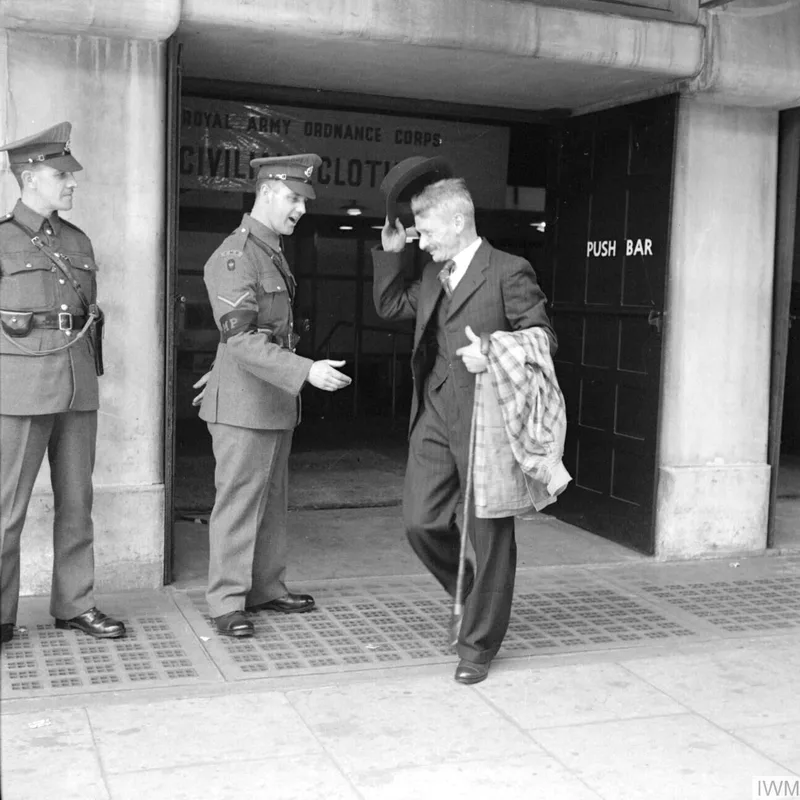
The photo at the top shows the idea. A man walks out of the clothing depot at Olympia in London, a civilian again.
RAF and Navy papers look different
This guide focuses on the Army book. The other services used their own papers. The IBCC Digital Archive holds several RAF “service and release” books. One belonged to a warrant officer who served in the RAF Volunteer Reserve from 16 November 1942 to 11 December 1946 and was released in Class A.
For the next step, see our RAF WW2 service records and Royal Navy WW2 service records guides.
What to do with it now
- Copy the army number exactly. It is the key to everything. Our service number guide explains why.
- Note the unit and the dates. They narrow down where he served last. Our guide to finding which battalion grandad served in covers the next step.
- Order his service record. Follow our WW2 Army service records guide. The release book is not the record, but it gives you what you need to apply.
- Decode the abbreviations. Release papers are full of them. Try our service record abbreviations guide.
Look after it
Demob papers are thin card and cheap paper. Store them flat, somewhere cool and dry, with paperclips removed. Never laminate or tape them. Our preservation guide has the full advice. Photograph every page first, including the testimonial.
FAQ: WW2 release books and demob papers
What is a Soldier's Release Book?
The book a soldier was issued when he was released from the Army after the Second World War. The National Army Museum catalogues examples as 'Soldier's Release Book. Class A. Army Book X 801', including one used by Tpr Ralph Hooper of the Royal Armoured Corps and No 5 Commando, dated 20 December 1945.
What is the difference between Class A and Class B release?
Class A was the main scheme, by age and service group. Class B released men early for urgent reconstruction work, mostly the housing programme but also coalmining and teaching. In August 1945 George Isaacs told the Commons in a statement on manpower that Class B releases would not exceed 10 per cent of Class A releases.
How was a man's release group worked out?
By his age and length of service. The National Army Museum says soldiers were released according to age and length of service, and in 1946 the War Office told the Lords that releases were governed primarily by age and service groups. We have not printed the exact formula here because we could not check it against a source we could open.
What was in a demob suit outfit?
The National Army Museum says each man was given a choice of suit and issued with a raincoat, a shirt with two collars, a hat, a tie, shoes and two pairs of socks. Women received a cash grant and clothing coupons.
Did RAF men get a release book too?
Yes, the RAF issued its own papers. The IBCC Digital Archive holds several RAF 'service and release' books, including one for a warrant officer released in Class A after serving in the RAF Volunteer Reserve from 16 November 1942 to 11 December 1946.
Can I get his service record from a release book?
The release book is not the full record, but it usually gives his army number, rank and unit. That is what you need to apply. See our WW2 Army service records guide.
Sources
Checked 3 November 2026.
- National Army Museum: Soldier's Release Book Class A, Army Book X 801, Tpr Ralph Hooper
- National Army Museum: Soldier's Release Book Class A (Army Book X801) of P/Lance Sgt Joe Ashley
- National Army Museum: Demobilisation suit, 1945 (c)
- National Army Museum: Release and Resettlement booklet (NAM.2011-01-7-33)
- Imperial War Museums: Soldier's Class 'A' Release Book, December 1945 (Documents.5377)
- Hansard: Man-Power (Re-allocation), HC Deb 23 August 1945
- Hansard: Ex-Service Personnel (War Gratuities), HC Deb 6 February 1945
- Hansard: Demobilization of Officers, HL Deb 26 February 1946
- IBCC Digital Archive: Cyril Abbotts' service and release book
- Monte San Martino Trust Archives: Collier, Bernard
- BFG Locations forum: Soldiers Release Book (a family's transcription)