
- Home
- Letters & Documents
- WW2 censor stamps and field post offices
WW2 censor stamps and field post offices: how to read the envelope
The letter was written to get past the censor. The envelope is often where the Army left its own marks.

Start with the envelope. The letter is what he wanted to say. The cover is what the Army was willing to let through, and it often carries the only firm date you will get.
Key facts
- Why letters were thin on detail
- They were read, and anything useful to the enemy could be cut or stopped
- Unit censor
- Examined ordinary forces letters before they went into the military mail
- Green envelope
- For private and family letters only; censored at the base, not by the unit
- Misuse
- A soldier was confined to barracks for 10 days in a case raised in the Commons in April 1941
- Field Post Office mark
- A military datestamp. It dates the letter; it does not, on its own, name the unit
- Keep the envelope
- The marks are often only on the outside
Censorship practice and the green envelope from Hansard, 22 April 1941. Postal arrangements from Hansard and an official 1944 photograph. Checked November 2026.
Censorship is why so many wartime letters feel oddly empty. Men learned not to name a place, a ship or a next movement. Our guide to reading WW2 letters is about those gaps. This page is about the marks on the outside, and about the one official loophole the War Office explained in public: the green envelope.
Two kinds of censor
By the time a letter left a unit, it had normally been read. The Secretary of State for War made the distinction clear to the Commons on 22 April 1941.
Ordinary forces letters went through the unit censor. In practice that often meant an officer in the same unit. The point was not to police love letters. It was to stop information that could help the enemy.
The green envelope was different. It was an Army form, issued to the troops “for the transmission of letters relating to private and family matters only.” Its contents, Margesson said, “although censored at the base, are not examined by the unit censor.” A man could write to his wife without his own officers reading the page. He could not use the form as a free pass.
The base censor still had the right to open it, and to stop it.
The green envelope was easy to misuse
The April 1941 debate was not a quiet explainer. It was a row about a soldier who had written to the Conservative MP for South Croydon, Sir Herbert Williams, and had then been confined to barracks for ten days.
Margesson’s account was this. The soldier’s reply had been enclosed with another letter in a green envelope. “Neither of the two letters in question was of such a nature as to justify the use of the ‘green envelope,’ and the soldier was confined to barracks for 10 days for a breach of the censorship regulations. There was no question of punishing the man for writing to his Member of Parliament.”
Williams said the soldier had been writing at his request, and that a War Office official had wanted more detail about a complaint. He had not received the letter. Margesson’s reply is as close as we get to a description of what a base censor could do: “I presume the letter was stopped by the base censor and has not been forwarded because the green envelopes were being used for a purpose for which they were not designed.”
Two things follow, and they still help you read a family tin of letters.
First, a green envelope in the bundle means the letter was meant to be personal. It does not mean nobody read it. The base may still have done so.
Second, the form was tightly defined. Using it for a complaint, or for official correspondence, was a disciplinary matter. If you have a green envelope mixed in with ordinary covers, read the contents with that in mind.
The same exchange also settled, as far as ministers were prepared to go, that soldiers were not to be stopped from writing to their MPs. Margesson pointed back to a statement by his predecessor on 10 December 1940, and said he would not go beyond it. We have not opened that earlier statement for this article, so we have not quoted it.
What a Field Post Office mark can, and cannot, tell you
Many forces covers also carry a Field Post Office datestamp: a military postmark with a number and a date. It is evidence that the letter went through the Army’s own postal system, and it is often the best date you have, especially when the letter itself says only “Tuesday.”
It is tempting to treat the number as a code for his battalion. We have not seen an official public table that lets you do that with any confidence, and we are not going to invent one. Specialist catalogues exist; they are not a substitute for his service record or for the war diary of a unit you already have reason to believe he was with.
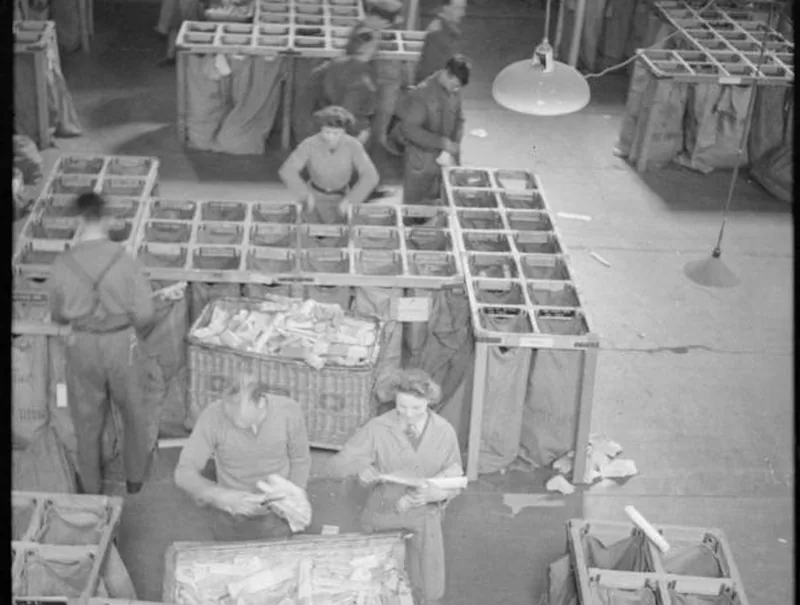
What the official record does show is the shape of the system. A Ministry of Information photograph from 1944, IWM D 20384, was taken in a disused dance hall in the Midlands that had become an Army Post Office. The caption is specific. Sorting was done by women of the Auxiliary Territorial Service and by men who had previously sorted for the General Post Office. “Mail is first sorted into the various branches of the services and then, from there, it is sorted into individual units. Large grids containing sacks are used to sort the letters and parcels into their various groups.”
So the Army did sort by unit. The datestamp on your envelope is still only a post office mark. Use the date, then test it against other papers, rather than reading a battalion into the number.
For outward mail to the Middle East in 1941, the Postmaster-General told the Commons that a new 3d air-mail postcard would be carried all the way by air “to the bases in the Middle East, where they will be delivered to the Army Postal Service.” The field system and the GPO met at those bases. Airgraphs and air letter cards used the same need to save weight; they still passed through this machinery.
How to read a cover, practically
Work in this order:
- Keep the letter in its envelope. Photograph both sides before you unfold anything brittle. The censor mark and the datestamp are easy to separate from the letter and lose.
- Note every printed or stamped line. A “Passed by Censor” mark, a number, a signature, a green-envelope heading, a Field Post Office circle, a date. Write them down as they appear, not as you wish they appeared.
- Use the date first. A firm date, even a partial one, is the hook for a war diary or a movement in his record.
- Don’t force the number to name a unit. If a specialist listing suggests an allocation, treat it as a lead and look for confirmation.
- Read the letter second. The letters guide covers the hints men tried to slip through, and why most of them are only guesses until a record backs them up.
If the sheet is a small photograph rather than folded paper, it is probably an airgraph. The original form was filmed; the print is what arrived.
Looking after what you’ve got
Ink on wartime envelopes fades, and gummed flaps tear. Don’t laminate the cover, don’t stick it down with tape, and don’t clean a censor mark to make it photograph better. Store the letter and its envelope together, away from damp and sunlight, as set out in our preservation guide.
The marks were never meant to be a family archive. They were meant to keep a war secret. That they survive at all is why they are worth reading carefully, and why they are worth not reading too much into.
FAQ: WW2 censor stamps and field post offices
Why were WW2 letters from the Forces censored?
Because a careless sentence could tell the enemy where a unit was, or what it was about to do. Ordinary forces letters were read before they left. In April 1941 the Secretary of State for War, Captain Margesson, told the Commons that green envelopes were issued 'for the transmission of letters relating to private and family matters only', and that their contents, 'although censored at the base, are not examined by the unit censor.'
What is a green envelope?
An Army form, not just a coloured stationery choice. It let a man write about private and family matters without his own officers reading the letter. The base censor could still open it. Using one for the wrong kind of letter was a breach of the censorship regulations. In the case raised in the Commons, a soldier who had put two letters in a green envelope, neither of them suitable for it, was confined to barracks for 10 days.
What is a Field Post Office stamp?
A military postmark, usually with a number and a date, applied when the letter went through the Army's postal service. It is good evidence of when the letter entered that system. It is not, by itself, a reliable label for his unit. Official photographs of an Army Post Office in 1944 show mail being sorted first by service, then by unit, into sacks. Matching an FPO number to a battalion is specialist work, and we have not seen a simple official public key for it.
Should I keep the letter in its envelope?
Yes. The censor mark, the Field Post Office datestamp and sometimes a date that the letter itself lacks are often only on the cover. Photograph both sides before they fade, and store them together. See our preservation guide.
Could a soldier write to his MP?
The War Office said he could, and that the man in the April 1941 case had not been punished for writing to a Member of Parliament. He was punished for putting the letter in a green envelope, which was the wrong form for that correspondence. The letter itself, the Secretary of State said, appeared to have been stopped by the base censor.
Sources
Checked 10 November 2026.
- Hansard, Letters to Members, 22 April 1941.
- Hansard, Post Office, Mail Service (Middle East), 2 April 1941.
- Imperial War Museums, D 20384, Army Post Office, correspondence and mail in wartime, England, 1944.
- Wikimedia Commons, File: Army Post Office- Correspondence and Mail in Wartime, England, UK, 1944 D20384.jpg (public domain).