
- Home
- Letters & Documents
- WW2 airgraphs and air letter cards
WW2 airgraphs and air letter cards: how to read what you've found
It looks like a small photograph of a letter, because that is what it is. The form was filmed, the film was flown, and a print went into an envelope at the other end.
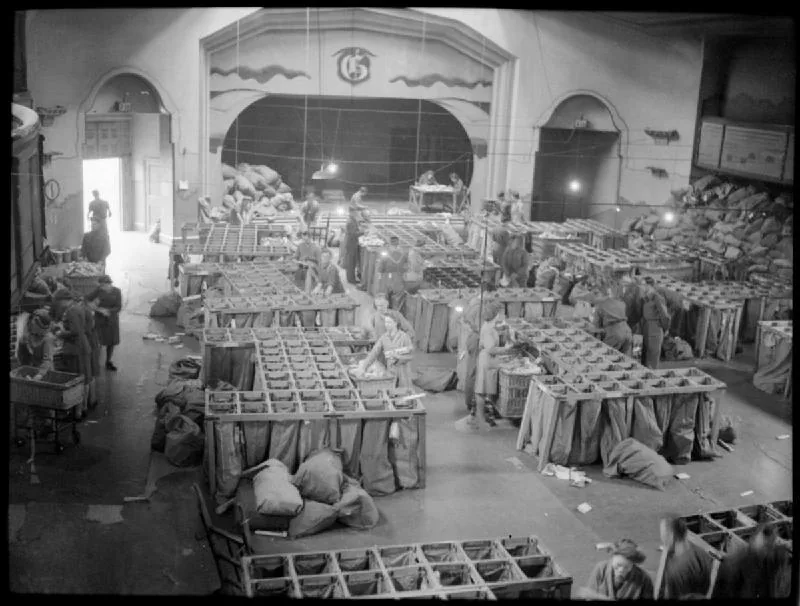

If you have pulled a small, glossy sheet from a wartime envelope, you are probably looking at an airgraph. It is not the paper he wrote on. It is a photograph of that paper, printed after the original had been filmed and flown.
Key facts
- What an airgraph is
- A photograph of a letter, printed from microfilm
- Who ran it
- The GPO, Kodak and BOAC, as described by The Postal Museum
- Forces rate, May 1942
- 3d; 8d to a civilian address
- Typical film time, Jan 1943
- About 8 days to the Middle East base; 15 days to India or South Africa
- Service ended
- 31 July 1945, according to The Postal Museum
- Air letter card
- A sheet that folds as its own envelope; 3d from the Middle East in 1941, except Egypt
Rates and timings from Hansard. How the service was organised, and the end date, from The Postal Museum. Checked November 2026.
That is why the writing can look faint, why the sheet is smaller than a normal letter, and why the family sometimes kept the little envelope it arrived in. Our letters guide explains how to read what he was allowed to say. This page is about the form itself: how the service worked, what it cost, and how it differs from an air letter card.
Why the GPO filmed the mail
By 1940, Italy’s entry into the war had made the Mediterranean a bad route for heavy mailbags. The Postal Museum puts it plainly: fewer flights, slower sea routes around Africa, and a still urgent need to get letters through for morale.
The answer was to stop flying the paper. The Museum says the Airgraph Service was developed by the General Post Office, Kodak and the British Overseas Airways Corporation. Writers used special forms. Those forms were photographed onto microfilm with Recordak cameras. Seaplanes carried the film. At the far end, Kodak technicians printed the images onto smaller sheets, which were put into envelopes and posted on.
One film roll, the Museum says, weighed about 155 grams and could carry up to 1,700 letters. Between 1941 and 1945, the GPO recorded that 300 million airgraphs were processed worldwide.
Kodak did the photographic work. In January 1943 the Postmaster-General, W. S. Morrison, told the Commons that “the whole of the photographic work in connection with the airgraph service is performed on behalf of my Department, and of the other postal administrations concerned, by Kodak, Ltd.” The formal contract, he said, was still being negotiated. He also explained why the Post Office had gone to a private firm in the first place: Service mails had been delayed by diversion around the Cape of Good Hope, and Kodak already had the equipment and the trained staff “in all parts where it was being used.”
When it ran
A precise official start date is harder to pin down from the parliamentary answers we opened. The Postal Museum, quoting an account in Airgraph by the Forces Postal History Society, says that when the service began in May 1941, “it coincided with the heavy bombing and destruction of large parts of the City of London.” Treat May 1941 as that source’s date, not as a date we have seen on a Post Office notice.
The Museum says the service was terminated on 31 July 1945, because cheaper, improved air letters were becoming more widely available, and because wartime restrictions on air routes were easing.
It also spread as the war did. A written answer on 21 May 1942 said airgraphs could by then be sent to members of the Forces and to civilians in India, Ceylon and the Seychelles, and to civilians as well as the Forces in Egypt, Palestine, Transjordan, Cyprus, the Anglo-Egyptian Sudan, Aden and British Somaliland. In January 1943 Morrison told the House that a service to North Africa was “under consideration” and that he could not yet give a date.
What it cost, and how long it took
Use the official rates, not later approximations.
On 21 May 1942, Austin Grimston, answering for the Post Office, said:
- airgraphs to the Forces cost 3d;
- airgraphs to civilian addressees cost 8d;
- the 3d rate also applied to personnel of merchant ships, including those on ordinary commercial service, calling at ports in the countries concerned.
A Postal Museum blog published in March 2026 gives those prices as 3 shillings and 8 shillings. That is a hundredfold difference, and it does not match the Hansard figures, so we have not used it.
Speed was the point, but it was not magic. On 20 January 1943 Morrison said the planners had expected about two weeks to the Middle East base and about three weeks to India and South Africa. In practice, he said, the averages at that date were eight days and 15 days. Those times did not include the gap between posting and the film leaving this country, the photographic work at the far end, or the last stage of delivery, “all of which are subject to considerable variation.”
What you are holding
An airgraph is small, photographic and often slightly stiff. The handwriting may be pale. There may be a printed heading, a form number, and a serial. The envelope it arrived in is part of the object.
Don’t try to clean it, unfold it against a crease, or lift it with a sticky note. Our preservation guide covers safe storage. Photograph it, then transcribe it word for word, keeping his spelling.
Because the original form was filmed and, as a rule, not sent on, you should not expect to find the sheet he actually wrote on. The print is the letter, as far as the family is concerned.
Censorship still applied. Forms were read and sorted before they were filmed. For the marks that appear on ordinary forces envelopes, see our guide to censor stamps and field post offices.
Air letter cards are a different thing
An air letter card is not a photograph. It is a single sheet that folds to form its own envelope. If you have one, the outside is part of the letter. Keep it whole.
On 2 April 1941, Morrison told the Commons he was introducing a special 3d air-mail postcard service to the Forces in the Middle East, carried all the way by air, because ordinary air-mail letters still had to travel part of the way by sea. In the homeward direction, he said, an air letter card service at 3d had recently been introduced by the Army Postal Service for the Forces in the Middle East, except from Egypt. He regretted that the letter-card service could not yet be introduced from forces stationed in Egypt, “for reasons outside my control.” The new postcard service applied to all personnel of His Majesty’s Forces, including the Royal Navy.
If a family mix up the two, it is understandable. Both were cheap, both were designed to save weight, and both turn up in the same tins of letters. The test is simple. If it is a small photographic print, it is an airgraph. If it is a folded sheet that was itself the envelope, it is a letter card.
What to do with it now
Read it with the rest of the correspondence, not on its own. The date, the form type and any place he was allowed to name are clues you can take to his service record and to the war diaries. An airgraph will rarely give you a map reference. It will sometimes give you a mood, a rank, a ship, or a hospital, and that is enough to start.
FAQ: WW2 airgraphs and air letter cards
What is a WW2 airgraph?
A small photographic print of a letter. The writer used a special form. That form was photographed onto microfilm, the film was flown, and at the other end the image was printed onto a smaller sheet and posted on in an envelope. The Postal Museum says the service was developed by the General Post Office, Kodak and the British Overseas Airways Corporation.
How much did an airgraph cost?
On 21 May 1942 a Post Office minister told the Commons that airgraphs to the Forces cost 3d, and airgraphs to civilian addressees cost 8d. The 3d rate also applied to merchant seamen calling at the ports concerned. A later Postal Museum blog gives the prices as 3 shillings and 8 shillings; that does not match the Hansard figures, so we have used the official rates.
How long did an airgraph take?
In January 1943 the Postmaster-General said the average time to transmit airgraph mails to the Middle East base was eight days, and to India and South Africa 15 days. Those averages did not include the wait before the film left this country, the photographic work at the far end, or final delivery, all of which, he said, varied considerably.
When did the airgraph service start and finish?
The Postal Museum, quoting a Forces Postal History Society account, says microfilming in London began in May 1941, during the Blitz. It says the service was terminated on 31 July 1945, as cheaper air letters became more widely available and air routes reopened. We have not seen a formal start date in the Hansard debates we opened.
What is the difference between an airgraph and an air letter card?
An airgraph is a photograph of a form. An air letter card is the letter itself: one sheet that folds to make its own envelope. On 2 April 1941 the Postmaster-General told the Commons that a 3d air letter card service had recently been introduced by the Army Postal Service for the Forces in the Middle East, homeward, except from Egypt, and that a 3d air-mail postcard service was being introduced in the other direction.
Sources
Checked 10 November 2026.