
- Home
- Service Records
- Royal Marines WW2 service records
Royal Marines WW2 service records: how to get them
Marine records follow the Navy route, not the Army one. They have not moved to Kew yet, and that changes how you apply.
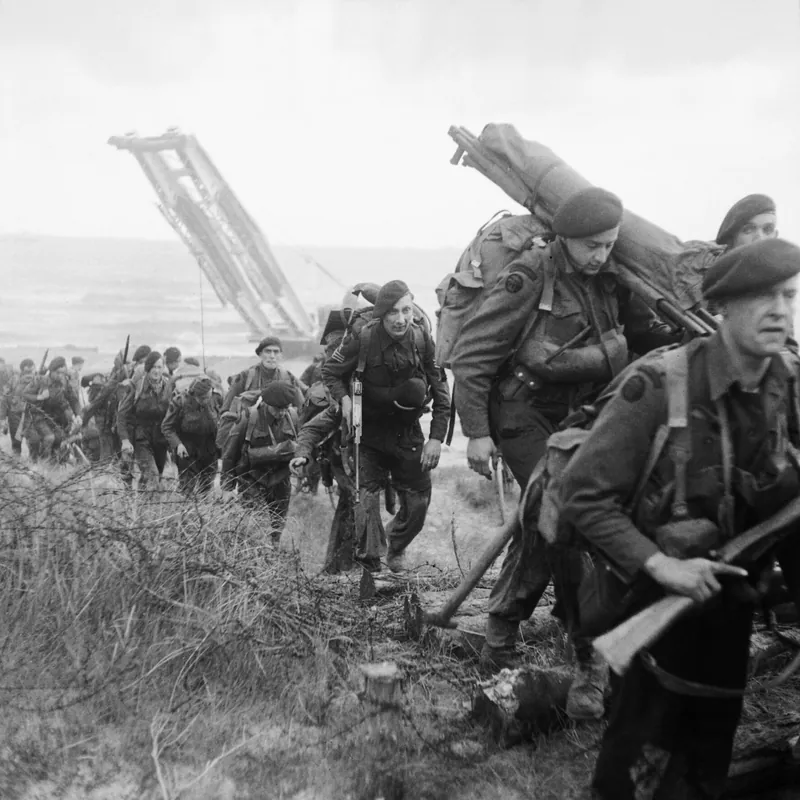

Royal Marines WW2 service records for men who enlisted after 1926 are still held by the Ministry of Defence, not The National Archives. Apply through GOV.UK. It is free. You need his full name and date of birth, and his service number if you have it. Expect a long wait: GOV.UK says the search can take up to a year.
Key facts
- Who holds them
- The Ministry of Defence, for men who enlisted after 1926
- Cost
- No fee to request records from the MOD
- Waiting time
- GOV.UK says the search can take up to a year
- You need
- Full name, date of birth, service number if known
- Earlier enlistment
- Men who enlisted up to 1926: search ADM 159 at Kew
- Unit records
- Royal Marines war diaries in ADM 202; Commandos also in DEFE 2
Checked against GOV.UK and The National Archives on 10 November 2026. The National Archives says Royal Navy records move to Kew in 2027; it does not separately confirm the same date for Royal Marines.
That is the same route as the Royal Navy. It is not the Army route. Army records for men born before 1940 are already at Kew.
Where are Royal Marines WW2 service records now?
With the MOD, in almost every WW2 case. The National Archives says service records for Marines who enlisted after 1926 are held by the Ministry of Defence. GOV.UK confirms the split: for the Royal Navy and Royal Marines, apply to the MOD for records of personnel who served after the First World War.
One exception is worth checking first. If he enlisted in or before 1926, and later served in the Second World War, an earlier register may already be online.
- Enlisted 1842 to 1926: search and download ADM 159 on Discovery (charges apply). Officers from the same period are in ADM 196.
- Enlisted after 1926: apply to the MOD.
- He also served in the Army or RAF: each service’s record is separate. Apply for each.
The National Archives says Royal Navy records are not being transferred until 2027. It does not separately confirm that Royal Marines files move on the same date. Until they do, all WW2 requests should go to the MOD.
How do you apply for a Royal Marines WW2 record?
Online or by post, through GOV.UK.
- Gather the details. Full name, date of birth, and service number if known.
- Find proof of death if you can. Not compulsory, but see below.
- Apply online, or download the request form and the relevant search form and post them.
- Wait for confirmation. The service acknowledges your application. Records come by post or email.
GOV.UK asks applicants not to submit more than 5 applications a month, because of demand.
Do you need a death certificate?
Not strictly. GOV.UK says you do not have to provide one. But without it, information may be withheld unless the person:
- died in service, or
- was born more than 116 years ago.
Online applications need the certificate as a PDF, PNG or JPEG. No certificate? Order a copy, or make a declaration of presumed death.
What will the record show?
GOV.UK says a record may include:
- rank, and regiment or corps
- dates he joined and left
- place and date of birth
- date of death, if he died in service
- good conduct medals
- career details, such as the units he served in
Medical and disciplinary details may be withheld. In some cases little or nothing survives. Be ready for that.
No service number? Try these first
A number speeds everything up. Look for it on:
- Discharge or release papers kept at home.
- His CWGC record, if he died in service. Search CWGC free.
- Family photographs and letters, which sometimes carry a number, a division or a unit.
Our guide to finding a WW2 service number covers every source.
Divisions, ships and units
Royal Marines records were arranged by division for much of their history. The National Archives names the original three: Chatham, Plymouth and Portsmouth. Before 1947, it says, Marines served on ships drawn from the same division as the ship’s home port. A division can still help you read later records, even if you apply to the MOD for the file itself.
The Royal Marine Light Infantry and the Royal Marine Artillery merged in 1923 to form a single Royal Marine Corps. A WW2 Marine was part of that combined Corps, whether he served afloat, in a landing craft crew, or in a commando.
What to read while you wait: the unit records
The service record should tell you his units and ships. The National Archives holds what those units did.
Royal Marines war diaries (ADM 202)
ADM 202 holds war diaries of the Royal Marine Division, Special Service and Commando units, training units and Mobile Naval Base Defence Organisations, plus reports and files on operations. Many pieces include photographs and maps. Search Discovery by the name and number of the unit.
Commandos and combined operations (DEFE 2)
The National Archives’ Army operations guide points to DEFE 2 for Royal Marine Commandos and for combined operations headquarters records. Search by special service brigade, commando unit or the code name of the operation.
If he served on a ship
- Ships’ logs (ADM 53): mainly navigational. Search by the ship’s name, without “HMS”, and restrict the dates.
- Reports of operations (ADM 199): reports, war history cases and the war diaries of commands and stations.
- Pink, red and green lists and the Confidential Navy List can place a ship or an officer. See our Royal Navy service records guide for the series.
HM ships did not keep Army-style war diaries. Do not look for one under the ship’s name. Look in ADM 202 for the Marine unit, and in ADM 53 or ADM 199 for the ship.
If he was a prisoner, or died
- Prisoners of war. ADM 201/111 is a nominal list of Royal Marines held as prisoners of war in Germany, 1939 to 1945. The National Archives points to the digitised lists on Findmypast (charges apply). See how to trace a WW2 prisoner of war.
- CWGC records Commonwealth war dead, including those with no known grave. See how to find a WW2 grave or memorial.
- Registers of reports of deaths on ships (ADM 104): free downloads from The National Archives.
- A Register of Royal Marine Deaths, 1939-1945. The National Archives recommends this published roll, which lists casualties by ship and unit and includes burial details.
Medals and gallantry awards
WW2 campaign stars were issued unnamed. The record and the ribbons are your evidence: see how to identify WW2 medals. Gallantry awards were published in the London Gazette. The National Archives notes that recommendations in WO 373 are mainly Army awards but do include some for the Royal Marines.
Medals never issued can still be claimed by next of kin. See how to claim WW2 medals.
Next steps
Apply to the MOD today. While you wait, search ADM 202 for his unit and, if he served afloat, ADM 53 and ADM 199 for his ships. For the naval side of the same process, use our Royal Navy WW2 service records guide. For free sources you can search tonight, start with free WW2 records online.
FAQ: Royal Marines WW2 service records
Where are Royal Marines WW2 service records held?
With the Ministry of Defence, for men who enlisted after 1926. GOV.UK says to apply to the MOD for Royal Navy and Royal Marines records of personnel who served after the First World War.
How much does a Royal Marines WW2 service record cost?
Nothing from the MOD. GOV.UK says there is no fee to request records from the MOD. The National Archives charges for records it already holds, including earlier Royal Marines registers in ADM 159.
Do I need a death certificate?
Not strictly. GOV.UK says you do not have to provide one, but without it information may be withheld unless the person died in service or was born more than 116 years ago.
Are earlier Royal Marines service records online?
Yes, for men who enlisted between 1842 and 1926. Search ADM 159 on Discovery and download the record (charges apply). A man who enlisted in or before 1926 and later served in the Second World War may have an earlier register there.
Did Royal Marines keep war diaries?
Yes. The National Archives holds Royal Marines war diaries, unit diaries, detachment reports and orders in ADM 202. Combined operations and commando records are also in DEFE 2.
Where are records of Royal Marines who were prisoners of war?
ADM 201/111 holds nominal lists of Royal Marines held as prisoners of war in Germany, 1939 to 1945. The National Archives points to the digitised lists on Findmypast (charges apply).
Sources
Checked 10 November 2026.
- GOV.UK: Apply for the records of a deceased serviceperson
- GOV.UK: Get a copy of military records of service
- The National Archives: Royal Marines other ranks
- The National Archives: Royal Marines officers
- The National Archives: MOD service personnel records fees, FAQs
- The National Archives: British Army operations in the Second World War
- The National Archives: Royal Navy operations and policy after 1945 (ADM 202 series guidance)
- The National Archives: ADM 202, Royal Marines war diaries and unit diaries
- The National Archives: Royal Navy operations in the Second World War
- The National Archives: Deaths in the First and Second World Wars
- CWGC: Find war dead